Toward Mobile Satellite Internet: The Fundamental Limitation of Wireless Transmission and Enabling Technologies

Abstract
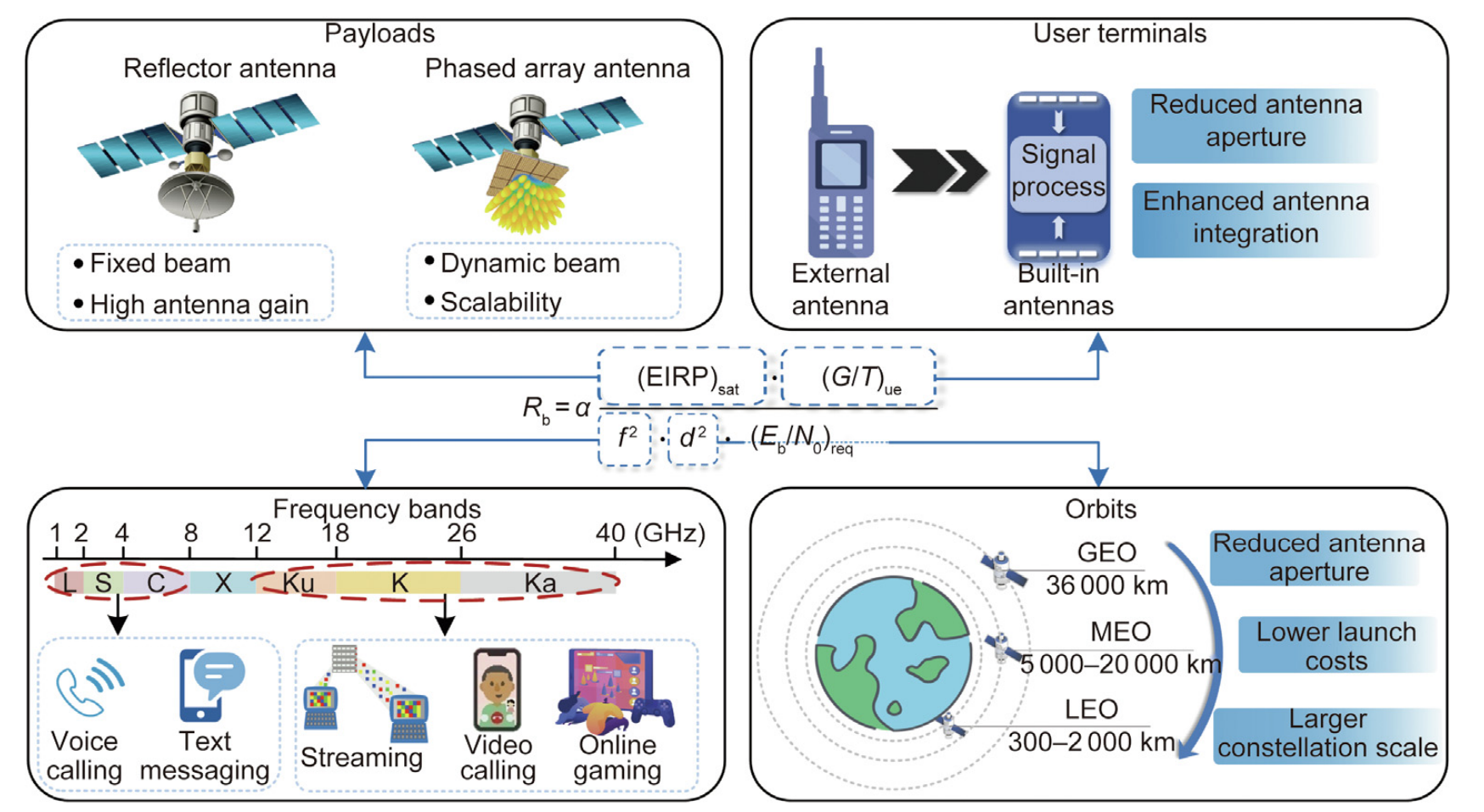
Low-Earth-orbit (LEO) satellites have emerged as a promising candidate for mobile satellite Internet, owing to the low launch cost, transmission latency, and path loss enabled by their low orbital altitude. However, while the low orbital altitude of LEO satellites offers these advantages, it also limits the coverage area of individual satellites and shortens the visibility duration over given locations, thereby necessitating the deployment of ultra-dense constellations to achieve seamless global coverage. In recent years, advancements in LEO satellite manufacturing and reusable launch vehicle technologies have stimulated the emergence of LEO mega-constellations, driving significant engineering efforts and commercial innovations in mobile satellite Internet [3]. A prominent example is SpaceX’s Starlink, which aims to deploy over 42 000 LEO satellites on several different orbit altitudes to provide global broadband Internet services [1]. In December 2024, SpaceX completed Starlink’s first direct-to-cell (DTC) LEO constellation, enabling unmodified fourth-generation (4G) long term evolution (LTE) handheld terminals to achieve Internet connectivity in remote areas [4]. In addition to being driven by demand and technology, the engineering and commercialization of satellite communication systems are constrained by manufacturing
Type
Publication
Engineering