Time-Continuous Frequency Allocation for Feeder Links of Mega Constellations with Multi-Antenna Gateway Stations

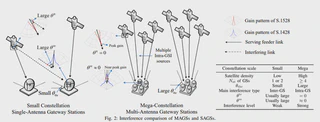 Image credit: Unsplash
Abstract
With the recent rapid advancement of mega low earth orbit (LEO) satellite constellations, multi-antenna gateway station (MAGS) has emerged as a key enabler to support extremely high system capacity via massive feeder links. However, the densification of both space and ground segment leads to reduced spatial separation between links, posing unprecedented challenges of interference exacerbation. This paper investigates graph coloring-based frequency allocation methods for interference mitigation (IM) of mega LEO systems. We first reveal the characteristics of MAGS interference pattern and formulate the IM problem into a K-coloring problem using an adaptive threshold method. Then we propose two tailored graph coloring algorithms, namely Generalized Global (GG) and Clique-Based Tabu Search (CTS), to solve this problem. GG employs a low-complexity greedy conflict avoidance strategy, while CTS leverages the unique clique structure brought by MAGSs to enhance IM performance. Subsequently, we innovatively modify them to achieve time-continuous frequency allocation, which is crucial to ensure the stability of feeder links. Moreover, we further devise two mega constellation decomposition methods to alleviate the complexity burden of satellite operators. Finally, we propose a list coloring-based vacant subchannel utilization method to further improve spectrum efficiency and system capacity. Simulation results on Starlink constellation of the first and second generations with 34396 satellites demonstrate the effectiveness and superiority of the proposed methodology.
Type
Publication
arXiv
Note
Click the Cite button above to demo the feature to enable visitors to import publication metadata into their reference management software.
Note
Create your slides in Markdown - click the Slides button to check out the example.
Add the publication’s full text or supplementary notes here. You can use rich formatting such as including code, math, and images.
