Energy and computational efficient precoding for LEO satellite communications

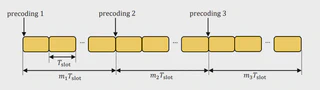 Image credit: Unsplash
Abstract
This paper focuses on energy efficiency (EE) pre-coding design and computational-efficient precoding updating strategy for low earth orbit (LEO) satellite communications. Firstly, we formulate the EE precoding problem, which aims to maximize the EE metric under the quality of service (QoS) constraint and per-antenna power constraint (PAPC). By intro-ducing semidefinite relaxation, first-order Taylor approximation, and quadratic transformation, the problem is transferred into a convex one that can be efficiently solved. Moreover, due to the continuous movement of LEO satellites, precoding is performed frequently to maintain the high EE performance, leading to high computational complexity. Consequently, we consider prolonging precoding intervals to reduce complexity while alleviating severe performance degradation during the intervals. To this end, a computational-efficient beam direction change (BDC) algorithm is proposed to update pre coding vectors, which makes the main lobes of beams always point toward users. Furthermore, an adaptive method is proposed to adjust the precoding interval flexibly. Simulation results have indicated the effectiveness of the EE precoding algorithm and the BDC algorithm.
Type
Publication
2023 IEEE Global Communications Conference (GLOBECOM)
Note
Click the Cite button above to demo the feature to enable visitors to import publication metadata into their reference management software.
Note
Create your slides in Markdown - click the Slides button to check out the example.
Add the publication’s full text or supplementary notes here. You can use rich formatting such as including code, math, and images.
